
Google’s New OKF Is Hot. Do You Actually Need It?

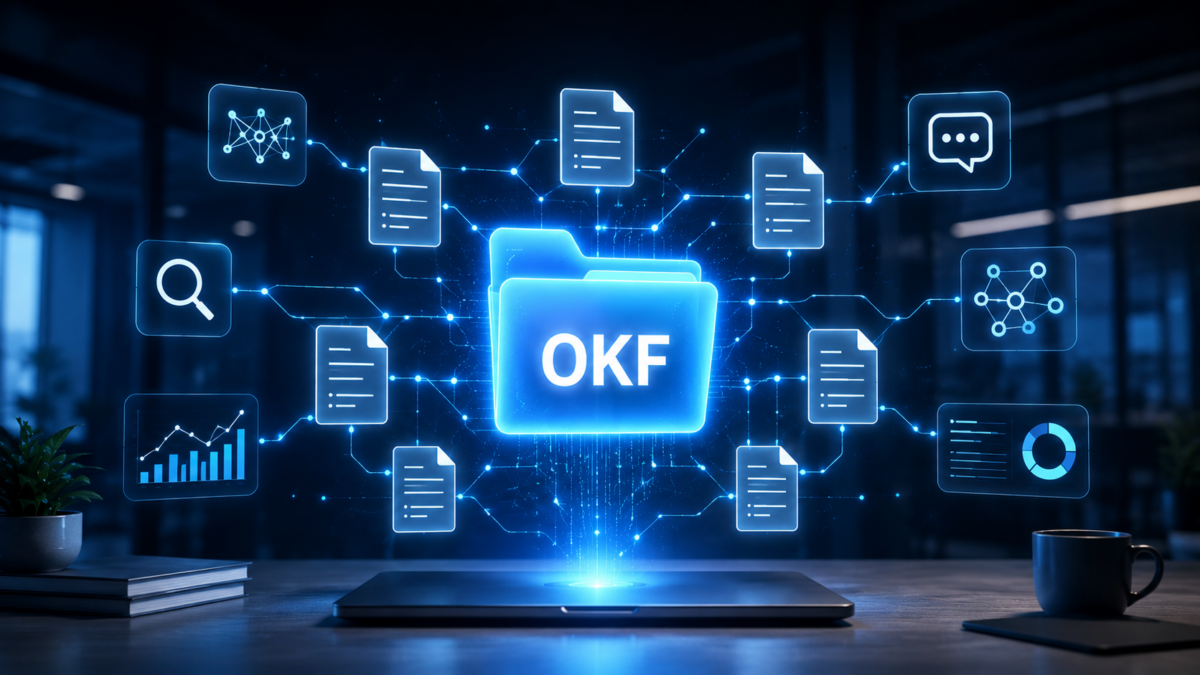
Google’s new OKF is hot off the press. There’s a lot of hype around it, so let me explain what it is and why it may matter to you.
An OKF “bundle” is a directory of Markdown files. Each file explains one concept, such as a product, service, policy, or process, and includes a small block of structured information.
The files can link to one another, creating a connected map of what a business consists of.
That map, at least in theory, could make information about a business easier for AI systems to retrieve, connect, and understand—provided the bundle is accessible to those systems.
Why does that matter?
Before the search and retrieval systems behind Google, ChatGPT, Claude, and other AI platforms can explain your business or recommend it to a potential customer, they must first find, read, interpret, and connect information about it.
Making your business easier for these systems to understand is an important part of relevance optimization for the modern search environment.
Some AI systems use retrieval-augmented generation, or RAG, to locate relevant information and incorporate it into a response.
Others use AI agents—software assistants that can decide what to investigate next, compare multiple sources, and complete a sequence of tasks on a user’s behalf.
OKF is designed to help systems like these consume structured knowledge. Because it uses clearly labeled, linked, plain-text files, it can make relationships between products, services, policies, processes, and other concepts easier to interpret.
That could become useful as more prospective customers turn to Google, ChatGPT, Claude, and similar tools to research products, compare services, and identify businesses.
If these systems can access and correctly understand what your company offers, whom it serves, how its services connect, and why it is credible, your business may be better positioned to appear in relevant research and recommendation workflows.
But OKF Is Not a New SEO Requirement
This is where I’d slow down a bit and make sure we’re making a sober, realistic assessment.
OKF came from Google Cloud’s data and analytics organization, not the Google Search team.
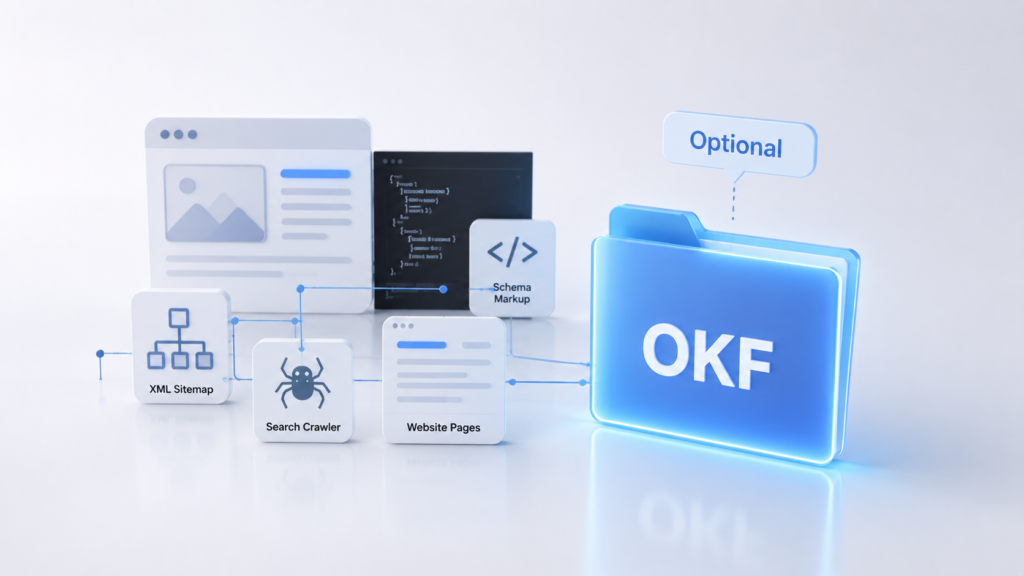
Google has not announced OKF as:
- A ranking factor
- An AI Overview requirement
- An AI Mode optimization feature
- A crawler directive
- A replacement for schema markup, XML sitemaps, or normal web pages
Does that mean OKF is irrelevant? Absolutely not.
In fact, one could argue that one should not expect Google to tell the whole truth about how to manipulate its systems to rank and recommend you more.
But the fact remains that you should treat any claim that publishing an OKF folder will improve rankings or earn more ChatGPT and Google AI citations as speculation.
This may become a confirmed future use case, but it has not been proven.
Does Your Business Need OKF?
For most small and midsize businesses, my answer today is:
Probably not yet.
A local contractor with weak service pages, inconsistent business information, poor reviews, and indexing problems will not fix those issues by creating an OKF bundle.
The same applies to a professional-services company whose website does not clearly explain who it serves, what it does, where it operates, or why a buyer should trust it.
OKF becomes more relevant when a company:
- Has large amounts of valuable knowledge spread across several systems
- Is actively developing internal or customer-facing AI agents
- Maintains extensive technical documentation, datasets, APIs, or product information
The Bigger SEO and AEO Lesson

Although most businesses probably don’t need to implement OKF today, they should pay attention to what it represents.
My larger takeaway, which hopefully you can also recognize, is that search has moved beyond finding pages that mention the correct words.
AI systems increasingly need to retrieve specific facts, understand how those facts relate, determine which version is current and reliable, and assemble the information into an answer or action on behalf of users.
Your competitive advantage is therefore becoming less about publishing the highest number of pages and more about maintaining the clearest, most reputable, best-connected source of truth.
- Category: SEO
- Tag: AI optimization, digital marketing, GEO, SEO

Posted by Caleb Turner
Caleb Turner is the founder and owner of SEO Rank Media, a results-focused digital marketing agency specializing in SEO, PPC, and AI-ready search visibility. With over a decade of experience helping businesses improve rankings, traffic, and online growth, Caleb is known for using customized, data-driven strategies instead of generic SEO playbooks.