AI Search Is Becoming Agentic: How I Would Prepare a Brand Now


How brands can earn AI visibility, selection, and agentic action

There are two distinct things happening in AI search, and I think most people are blurring the lines between them.
First, there’s AI search optimization. That’s about being found, understood, cited, and picked when someone asks an AI a question your brand could answer. Second, there’s agentic optimization. That’s different. That’s about helping an AI actually finish a task on your site, whether that’s booking something, buying something, or filling out a form.
Both matter. Neither is optional anymore. That’s the whole game in a nutshell. Get retrieved, get understood, get chosen, and make sure the path after that doesn’t fall apart.
Key takeaways:
- AI search recommends, agentic search acts, and your site needs to be ready for both.
- SEO fundamentals are still the base everything else should be built on.
- Clear facts, direct answers, and credible mentions drive both retrieval and preference.
- Semantic HTML and stable forms make your site usable for agents, not just humans.
- Measure real business outcomes, not just how often you get cited.
What Is the Difference Between AI Search and Agentic Search?
Here’s the real difference between AI search and agentic search. It comes down to what happens after the system finds the information.
AI search retrieves sources, weighs the evidence, and hands you a recommendation. Agentic search doesn’t stop there. It can include navigating a site, filling out a form, checking if something’s in stock, requesting a quote, or knocking out whatever task actually needs doing. In this way, it serves as the user’s “agent”.
A few ways to think about where each approach draws the line:
- Traditional SEO asks one question: can a human or machine even find this page?
- AEO and GEO push further: can the machine understand the content, retrieve it, cite it, and actually prefer this brand over the next one?
- Agentic optimization goes a step beyond that: can the machine get the user’s goal accomplished with this specific business, not just talk about it?
I got into some of this with Tory Gray, an SEO strategist I interviewed recently. I didn’t want another surface-level chat about ranking in ChatGPT. We dug into rendering, prompt tracking, server logs, the standards still taking shape, and what agents might actually start doing on a website soon.
Tory made a point that I agree with. AI search is mostly SEO with a few new channels bolted on. Agentic work is a different animal entirely. The bots are different, the actions are new, the requirements keep shifting, and nobody has measurement fully figured out yet.
I agree with her on that one.
Why Does Agentic Search Matter Now?
Here’s what I’m seeing right now, and I think most people are misreading it.
Google Agent is Google’s named fetcher for Google-hosted agents that can navigate the web and act on a user’s behalf. That’s it. It’s not a product name you’ll see marketed anywhere, and it’s definitely not Googlebot. Googlebot builds the search index. Google Agent represents something different: a live task being carried out on someone’s behalf in real time on behalf of the user. And as I mentioned earlier, this is agentic search.
I’ll be straight with you, it’s not a complete picture either. Google hasn’t mapped this identity to every agentic product it runs, so we’re looking at part of the activity, not all of it.
Project Mariner as a standalone experiment is done. But don’t mistake retirement for disappearance. That browser automation work didn’t vanish; it just moved. You’ll find it now inside Gemini Agent and baked into the agentic features showing up in AI Mode. Chrome Auto Browse also now delivers the same broader class of browser automation directly inside Chrome.
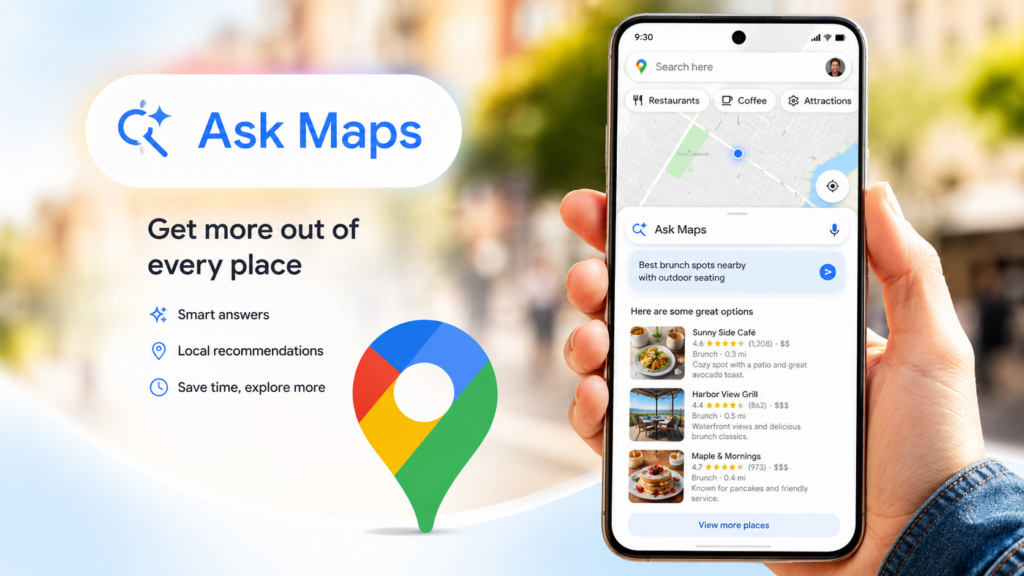
If you care about search strategy, AI Mode is where I’d focus. Google has said the action layer there can pull together live web browsing, partner integrations, the Knowledge Graph, and Google Maps all at once.
On my end, I keep the traffic separated because lumping it together tells you nothing useful. Googlebot, OAI SearchBot, Claude SearchBot, and PerplexityBot are your search and indexing crawlers, plain and simple.
ChatGPT User, Claude User, and Perplexity User are different; that’s user-directed retrieval: someone asked for something specific, and the bot went and got it. Then you’ve got Google Agent and signed ChatGPT Agent traffic, which can mean actual operation on a site. And local browser agents are the trickiest of all, because half the time they just look like normal human traffic.
Here’s why any of this should matter to you. A brand can do everything right. Rank well, get recommended by the AI, check every box, and still lose the customer at the finish line. Why? Because the agent hit a firewall challenge, or got stuck on a CAPTCHA, or timed out, or ran into a broken form, or the page was labeled in a way the machine couldn’t parse. The visibility battle isn’t the only battle anymore. The second question is whether the path from recommendation to action actually holds up, and it needs to hold up for machines just as much as it does for people.
How Should You Optimize for AI Search?

I recommend starting with the pages closest to revenue. The service and product pages that actually drive decisions. That kind of page has to answer the main question immediately, make it obvious who it’s for, walk through what working together looks like, and handle the objections buyers already have in their head before they even ask.
Here’s the part most people miss. Every section should ideally give its answer right away, not three sentences in, after some warm-up. AI systems usually pull a single chunk of a page, not the whole thing. If that chunk can’t stand on its own, it never gets used, no matter how good the rest of the page is.
Once the on-site work actually holds up, I go look everywhere else. Because that’s really where trust gets built or lost.
Getting retrieved is step one. Getting picked is a completely different issue, and it often comes down to whether the evidence outside your website backs up what you’re claiming on it.
How Should You Make Your Website Agent-Ready?

Here’s what I actually do when I audit a site for agent readiness. I don’t click through a few pages and call it good. I run the entire flow start to finish, whether that’s a quote, a booking, a checkout, an application, or just a basic contact form. That’s where the real problems live, not in some surface-level page review.
I check the real links, real buttons, real labels, real inputs, and real select controls. Every interactive element needs a name a machine can actually read, and every label has to be properly tied to its field. This isn’t optional anymore. Chrome has said flat out that agents rely on the accessibility tree to understand a page, so accessible names, stable layouts, and the emerging WebMCP support matter more than most people realize right now.
Rendering is where things tend to fall apart. If your JavaScript is fragile, some retrieval systems only see half the page, sometimes an empty shell and nothing else. And if your layout shifts late, an agent can click the wrong thing simply because a button moved half a second too late. So my audit covers all of it. The raw HTML response, what actually renders, the accessibility tree, layout shift behavior, server responses, and whether the whole workflow completes cleanly from start to finish.
Example: An Agentic Local-Service Journey

Let me walk through a real example, because I think this is where people get the mental model wrong.
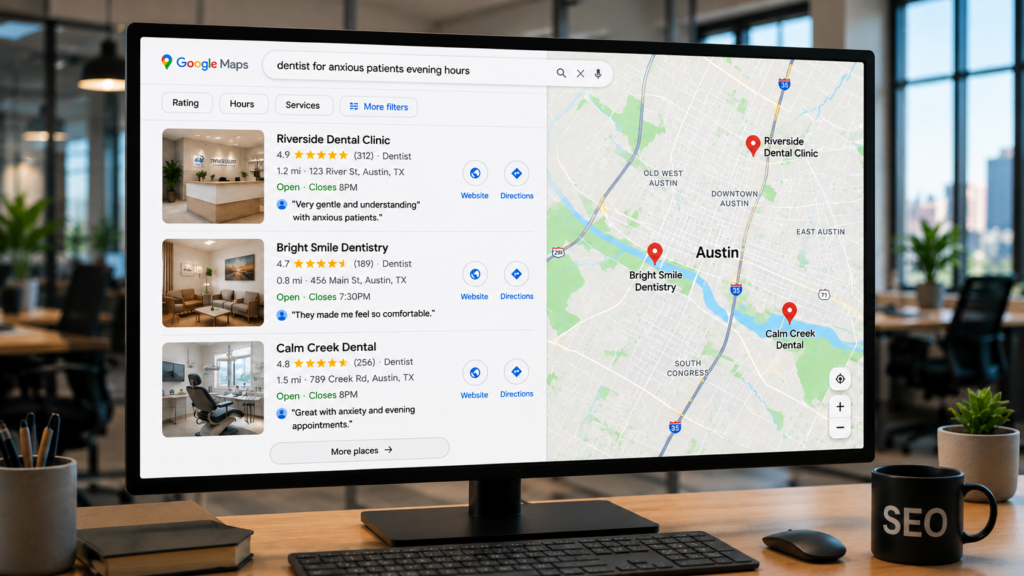
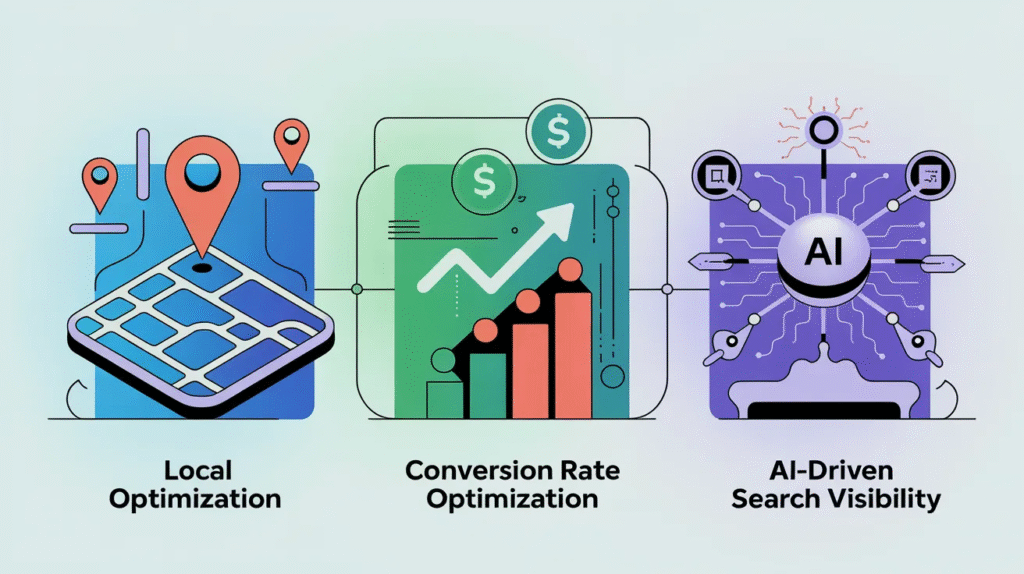
Someone asks an AI assistant to find a reputable roof cleaner near Charleston, one that does soft washing, and they want an estimate this week. The first job for the system is just finding businesses that actually fit that ask. That part is SEO and AEO. It’s pulling from search results, maps, service pages, reviews, whatever signal exists out there.
Then comes the sorting. Out of everything it found, which business actually matches what this person needs? Location, method, reputation, can they even get there this week, whatever proof exists that this company is the real deal. That’s not regular SEO doing the work anymore. That’s AEO, relevance optimization, and maybe conversion rate optimization deciding who earns the pick.
Here’s the part most people miss, though. Even after a brand wins that comparison, even after it’s clearly the best match, there’s still a third job waiting. The system has to go to that website and actually submit the estimate form on the person’s behalf. This third job is where agentic search comes into play.
And I’ve watched good businesses lose leads they already won right here. The form doesn’t fill in correctly. It hits a bot detector and stalls. The fields are vague or mislabeled, so the system can’t figure out what goes where. All that effort getting found and getting picked, and it falls apart because the technical door never opened.
Which Emerging Technologies Deserve Attention?

I want to flag a few emerging technologies worth watching, because they’re tied to real business use cases instead of just being noise. WebMCP, mentioned earlier in this article, is the one I’m paying closest attention to. Chrome describes it as a proposed standard for exposing structured website tools to AI agents. So instead of an agent fumbling through a form field by field, guessing what goes where, it could just call a defined tool request_estimate and skip straight to the outcome.
That said, WebMCP is still in the early days. I wouldn’t commit serious engineering time to it unless you’ve got a repeatable, valuable action that actually justifies the build.
The same logic applies to llms.txt. It’s not a proven ranking factor, but it can help AI agents understand and navigate through a website, which is where I see potential value.
Google’s Open Knowledge Format is a different thing entirely. It structures portable knowledge in Markdown with metadata, but it’s not a universal standard for public search or website actions. People blur these together, and it just creates confusion.
How Should You Measure AI Search and Agentic Performance?

I measure AI search and agentic performance across behavior, visibility, and business results. Tory and I got into this exact model because citations alone don’t prove anything. A brand can get cited all day and still not see a dime of value from it.
Start with the logs. Go into your server and CDN logs and see which bots and agents are actually touching your assets, and whether they’re getting blocked with 403s, throttled with 429s, timing out at 499, or hitting 5xx errors. When speaking about agentic bots: Google Agent and verified, signed ChatGPT Agent traffic deserves first-class treatment in your metrics. But here’s the blind spot nobody talks about enough. Claude in Chrome, Browse with Copilot, Perplexity Comet, and a growing pile of custom agents often just look like regular browser traffic. You won’t always know an agent touched your site unless you go looking for it.
From there, track a stable set of high-intent prompts over time. Watch for mentions, citations, which sources get selected, whether the facts are even accurate, and your share of voice against competitors. This is directional. It’s a sample, not a real record of what real customers are doing across every possible query.
Then tie it all back to something that actually matters. Qualified traffic, assisted conversions, leads, and revenue. I said this in an interview and I’ll say it again. I care about revenue. I care about leads. I care about driving real business value from this work. Visibility is a leading indicator; it tells me something is working before the revenue shows up, but it’s never the final score.
Which Tools Help Research and Measure This Shift?

There’s a plethora of new tools flooding the market right now, and honestly, most of them do very specific jobs. Exa pulls relevant webpages and passages for AI systems. DataForSEO gives you the bigger picture on SEO and AEO data. SerpApi shows you exactly what a search interface is returning at a given moment. Different tools, different purposes.
Here’s what I’ve learned running SEO Rank Media. The tool itself isn’t the point. What matters is whether it gets my clients the result they actually need. So we use all of it, plus our own internal AI and automation, to pull in the kind of information that actually moves the needle.
At the end of the day, I’m not trying to sell anyone on a piece of software. I’m building a strategy around the business in front of me, and I’ll pull whatever tool fits that job. That’s the whole approach. Customize first, then figure out which tools get you there.
What Should You Do Next?

Preparation for agentic search comes down to the path from discovery to recommendation to action, and you need to strengthen every step of it.
Start with the technical SEO foundation. Then make your key claims answer-ready, so an AI can actually pull them out and use them without guessing. After that, go audit how AI tools are already describing your brand. You might be surprised, and not always in a good way. Last step, and the one people skip, is testing whether an agent can actually complete a real customer journey with you, start to finish.
If you want a real baseline instead of a guess, I offer an AI visibility and agentic readiness audit. Reach out to me, and I’ll show you exactly where your brand is getting retrieved, where you are losing preference to someone else, and where technical friction is quietly blocking your next round of qualified leads.