Answer Engine Optimization (AEO) Explained: What It Is, What Services an AEO Agency Provides, and Who Needs It
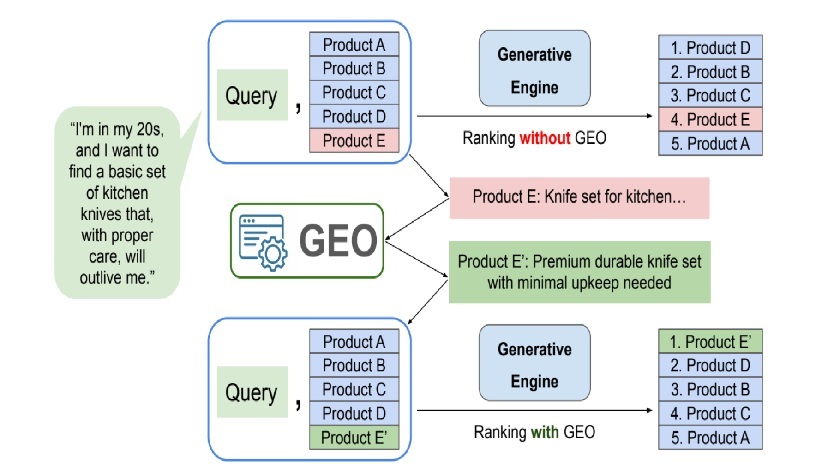
Answer Engine Optimization (AEO)—sometimes called AI search optimization or Generative Engine Optimization—helps your brand, products and services appear in AI‑generated answers by structuring content, data and authority so that AI systems can understand and quote it. For companies seeking an AEO agency in Los Angeles, this article explains what AEO is, what services agencies provide and who benefits from them.
Key Takeaways
- AEO ensures your brand appears in AI‑generated answers and voice assistants.
- It complements SEO and paid ads by helping you get chosen, not just found.
- AEO agencies align content, entities and structured data for AI comprehension.
- B2B SaaS, professional services, high‑consideration products and local services benefit most.
- When hiring an AEO agency in Los Angeles, ask about outcomes, schema, content structure and measurement.
AI search is changing how people find products and services. More than 60 percent of Google searches now end without a click, and voice or conversational queries will account for roughly half of all queries in the coming years. When a buyer types “best onboarding software” into an AI‑powered platform such as Perplexity or ChatGPT, the answer engine doesn’t show a list of blue links, it gives a curated comparison. If your brand isn’t mentioned in that answer, you don’t even exist to that buyer.
That’s where answer engine optimization comes in. AEO prepares your content and entities so AI systems understand them, cite them and include them in answers. This explainer will demystify AEO in plain language, compare it to traditional SEO and paid ads, outline what an AEO agency does, describe who needs this service, and provide practical guidance on hiring the right partner.
What “AEO” stands for (in plain English)

In simplest terms, AEO is the practice of making your brand, products and information easy for AI-powered search engines to understand and quote. Unlike traditional search engine optimization (SEO), which focuses on getting your website to rank in the top positions of a results page, AEO increases the probability that your information is selected and presented inside AI‑generated answers. Instead of only being concerned with clicks, AEO also aims to get your brand mentioned or cited by answer engines.
AEO in practice
When someone asks an AI engine, “Which accounting software should a Los Angeles–based startup use?” the model quickly scans its knowledge sources, decides which entities and products are relevant, and then constructs a concise answer. A company optimized for AEO will have:
- Clear entities—The company name, product names, modules and key use cases are defined consistently across its website and third‑party profiles.
- Structured data—Pages include schema markup (e.g., FAQ, Product, Organization, HowTo) that tells AI engines exactly what each piece of content is about.
- Answer‑ready content—Content is formatted using question‑and‑answer style summaries, concise bullet lists and headings that align with the questions buyers ask.
Because of these signals, the answer engine can quickly extract the relevant information and highlight the brand in its summary. That is the essence of AEO: help AI help your customer find you.
AEO vs. SEO vs. paid ads: what’s different
SEO, AEO and paid advertising all aim to put your business in front of potential customers, but they operate differently. The table below summarizes the core distinctions.
| Approach | Goal | Target surfaces | Optimization techniques | Typical outcome |
| Search Engine Optimization (SEO) | Improve rankings in traditional search results | Google/Bing organic results | Keyword research, on‑page optimization, link building, technical SEO | Drives clicks to your website to read longer‑form content |
| Answer Engine Optimization (AEO) | Get included in AI‑generated answers and voice responses | AI Overviews, ChatGPT Search, Perplexity, Google Bard, Claude, etc. | Entity modeling, schema markup, concise Q&A content, authority building | Delivers direct brand mentions, citations, and/or comparisons. |
| Paid Advertising | Purchase visibility in search results or social platforms | Google Ads, LinkedIn, Facebook, display networks | Bidding on keywords, targeting audiences, ad creative | Generates traffic immediately but disappears when you stop paying |
AEO doesn’t replace SEO or advertising, it complements them. Traditional SEO is still needed to build foundational organic search engine visibility, while paid campaigns can generate immediate awareness. AEO ensures that when buyers ask AI engines for recommendations, your brand is in the conversation. Put another way: SEO helps you get found, AEO helps you get chosen.
Why AEO matters now
AI search results are increasingly zero‑click: more than 60 percent of queries end without a user visiting a website. Voice and conversational queries are growing. Consumers expect quick, authoritative answers and don’t have patience to sift through ten links. Without AEO, even strong SEO performance may not translate into visibility within AI‑generated answers. Companies that invest early will be first to gain brand mentions and build authority in this new channel.
What an AEO agency does

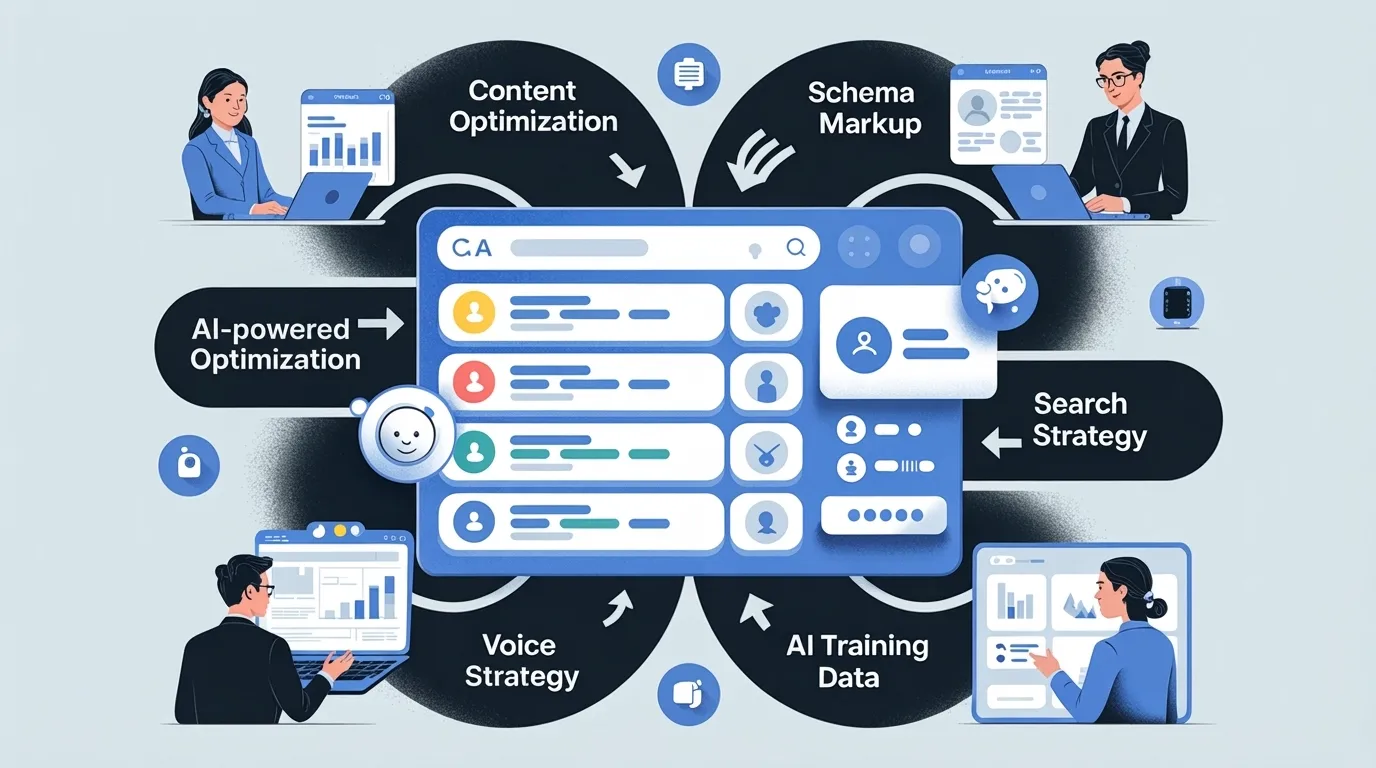
A professional AEO agency helps brands build and maintain answer‑readiness across content, entities and technology. While specific offerings vary, most agency service menus include three pillars: content and knowledge‑base alignment, structured data and entity optimization, and measurement and iteration.
Content + knowledge base alignment for AI answers
- Identify question and topic clusters. An AEO agency researches the exact questions potential customers ask in AI engines. They map these to intent patterns and buyer stages.
- Optimize content structure. Agencies rework existing pages and create new content so that AI models can easily extract answers. This includes adding clear headings, summaries, FAQs, and call‑outs aligned with question clusters.
- Refresh and consolidate content. They decide which pages to update, consolidate or retire to strengthen entity clarity and avoid conflicting information.
- Align knowledge bases and documentation. For SaaS and technical companies, agencies ensure product docs, help centers and blog posts use consistent terminology and entity relationships. This alignment increases the chance that AI engines cite your official content rather than random third‑party references.
Structured data, entities and citations/mentions

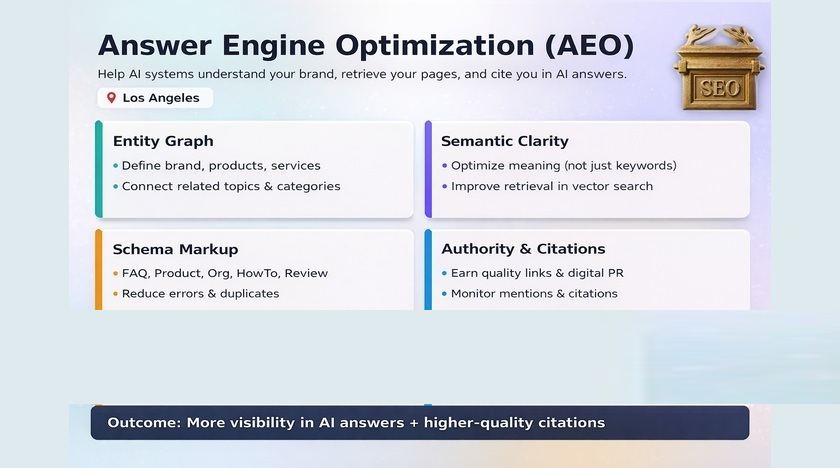
- Entity graph development. The agency builds a clear entity graph that defines your company, products, modules and related concepts. This helps AI models understand how your offerings relate to one another and to industry categories.
- Semantic optimization. Agencies go beyond keyword tweaks and optimize how meaning is expressed on the page so AI systems can encode your content into high-quality vector embeddings. Ensuring your pages are more likely to land “closer” to relevant queries in a vector index, improving semantic retrieval and increasing the chances your brand is surfaced in AI-driven search results and answers.
- Schema implementation. They implement structured data (FAQ, Product, Organization, HowTo, Review schema) that follows Google’s structured data guidelines and ensures AI engines interpret your pages correctly. Technical audits fix schema gaps and duplicate information.
- Citation and authority building. Agencies pursue high‑quality backlinks, guest posts, and digital PR to increase your domain authority and provide external signals for AI engines. They monitor brand mentions across AI platforms to ensure citations reflect accurate and positive information.
Measurement and iteration

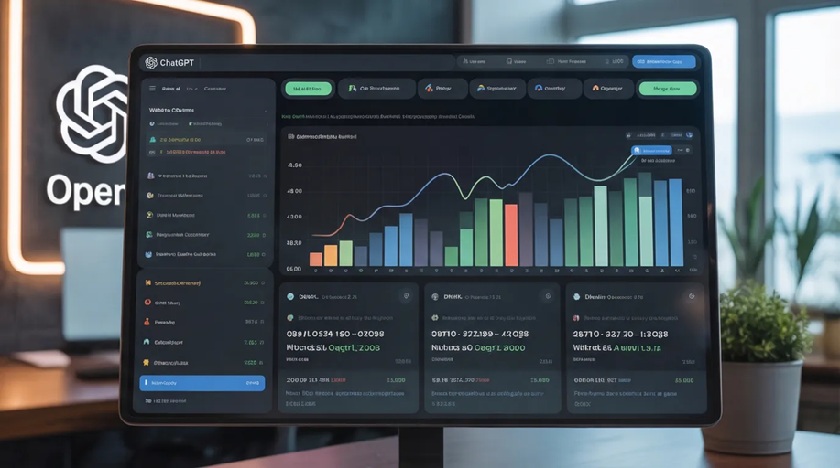
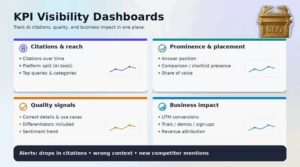
- AI visibility tracking. Traditional SEO metrics aren’t enough for AEO. Good agencies use specialized tools to track how often your brand is cited across AI Overviews, ChatGPT Search, Perplexity and Copilot. Metrics include citation frequency, position prominence, and context accuracy.
- Quality indicators. They analyze whether AI mentions capture the right details (use cases, differentiators) and whether sentiment is positive or neutral.
- Impact measurement. Agencies correlate AI visibility with pipeline growth—trials, demos, sign‑ups and revenue. They use UTM‑tagged links and branded search lift to see whether AI references drive conversions.
- Continuous improvement. As AI models evolve, the agency updates your schema, entities and content. They monitor AI outputs for misinformation and correct outdated product references. This ongoing cycle ensures your AEO program stays effective.
What type of clients do AEO agencies specialize in

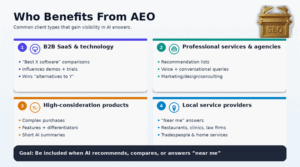
AEO is most impactful for businesses whose customers rely on research and comparisons before purchasing. Common client types include:
- B2B SaaS and technology companies. Buyers often ask “best X software” or “alternatives to Y,” so being present in AI comparisons directly influences demos and trials.
- Professional services and agencies. Firms offering marketing, design or consulting services must appear in voice and conversational queries; AEO helps them become part of recommendation lists.
- High‑consideration consumer products. Medical devices, financial products and complex home goods benefit when AI engines highlight their features and differentiators in short summaries.
- Local service providers. For restaurants, clinics, law firms and tradespeople, AI answers influence local “near me” queries. Over time, voice and AI searches will surface top businesses for these categories.
Does an AEO agency work with startups? What to expect
Yes. Startups and early‑stage companies can leverage AEO to gain visibility without large advertising budgets. According to startup guides, AEO allows young companies to become recommendable rather than merely searchable. Expect the agency to:
- Prioritize the most impactful products or ICP segments first.
- Build entity definitions and schema from scratch, aligning them with your go‑to‑market positioning.
- Educate your team about maintaining consistent product descriptions across marketing, product and customer success.
- Provide a realistic timeline: early citations and entity clarity may appear within 60–90 days, while category dominance and AI comparisons often take several months.
FAQs

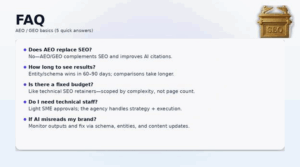
Does AEO replace SEO? No. AEO/GEO complements SEO. SEO still drives organic traffic and covers content formats that AI answers may not surface. AEO focuses on making sure AI engines correctly understand and cite your content.
How long does it take to see results? Early improvements in entity clarity and schema validation can appear within 60–90 days. Placement in AI comparisons and category queries may take multiple refresh cycles as AI models update their knowledge.
Is there a fixed budget? Budgets for AEO resemble specialized technical SEO retainers. Costs vary based on complexity and number of product lines. A strong agency will scope based on technical depth rather than simple page counts.
Do I need internal technical staff? You’ll need light involvement from product and content leaders for approvals and subject‑matter expertise. AEO agencies handle strategy and execution.
What happens if AI engines misinterpret my brand? An AEO agency will monitor AI outputs and correct misinformation by updating schema, entities and content.
How to hire an AEO agency for marketing services
To hire an AEO agency for marketing services, evaluate how well each partner understands AI search behaviour, entity modelling and multi‑engine visibility before you sign a contract. Below are key questions and proof requests to guide your hiring process.
What to ask during discovery
Use these questions to assess whether the agency truly specializes in AEO or just repackages SEO services:
- What outcomes will AEO deliver in the first 6–12 months? Ask how the agency will influence visibility in AI comparisons and how they’ll tie that to trials, demos and revenue.
- Which ICP segments and products will you prioritize? Strong partners focus on the ICPs and use cases that drive the most value.
- How will you map our ICP’s intent patterns and buyer journeys? Look for agencies that analyze AI queries and align content, schema and entities accordingly.
- How will you align AEO with existing SEO, paid media and lifecycle marketing? The agency should unify teams around shared entities and intent clusters.
- What makes you the best AEO agency for our industry? Ask for evidence of industry‑specific success, methodology transparency and clear expectations.
- How will you structure our entities and schema? Evaluate their process for building entity graphs and implementing structured data.
- How will you position us in AI‑generated comparisons? They should map competitors, categories and differentiators, then optimize content for extraction.
- What technical improvements will you prioritize? A good partner fixes schema gaps, improves internal linking and addresses duplicate infor
- How will you create answer‑ready content? Look for structured Q&A formats, concise summaries and entity‑aligned messaging.
- How will you monitor and correct AI misinformation? The agency must proactively check AI outputs and update content accordingly.
- How will you decide what to update, consolidate or retire? Strong partners audit existing pages, consolidate overlapping content and retire outdated material.
- How will you adapt as models evolve? Continuous monitoring and iteration are crucial.
- What data and benchmarks do you use? They should track citations, category placement and competitor visibility.
- How will you handle multi‑region or international AEO? Ask about region‑specific intent clusters and localized schema.
- How will you evaluate competitors? Insightful partners track competitor visibility and identify opportunities.
- How will SMEs contribute? They should interview your product and sales experts to capture nuanced features.
- How will you manage cross‑functional collaboration? Look for streamlined workflows that minimize your team’s workload.
- What does your 90‑day roadmap look like? A clear plan should prioritize schema fixes, content updates and monitoring.
- How will you report on progress before revenue impact? Early metrics include citation growth, entity accuracy and AI category presence.
- What level of access and communication can we expect? Monthly or biweekly check‑ins and transparent dashboards are standard.
- What ongoing maintenance will be required? AEO isn’t a one‑time project, continuous updates keep your brand in AI engines’ knowledge graphs.
What proof to request

To verify claims, request evidence that demonstrates the agency’s AEO capabilities:
- Visibility dashboards. Ask for anonymized dashboards showing citation frequency, summary prominence and category placement across multiple AI engines.
- Entity graphs and schema validation reports. These should illustrate how the agency defined a client’s entities and implemented structured data, along with resulting improvements in AI outputs.
- Client testimonials and references. Seek testimonials that mention measurable outcomes, such as increases in demos or trials triggered by AI visibility.
- Methodology documentation. Reputable agencies provide outlines of their workflow (intent mapping, schema implementation, content reformatting, monitoring, reporting) so you know exactly what to expect.
AEO Action Checklist
Use this quick checklist to start your own AEO program or evaluate a potential partner:
- Audit your existing content and identify question‑based queries relevant to your audience.
- Define your company, product and concept entities clearly across all pages and profiles.
- Implement FAQ and Product schema using Google’s structured data guidelines.
- Refresh and structure pages with clear summaries, question‑and‑answer sections and consistent terminology.
- Monitor AI visibility and adjust content and schema regularly as models and queries evolve.
Conclusion and next steps

AI‑driven search is no longer a novelty, it’s quickly becoming the default way people get answers, compare products and make purchasing decisions. Traditional SEO remains important, but alone it cannot guarantee your brand will appear in AI‑generated answers. Answer Engine Optimization, also known as Generative Engine Optimization, bridges that gap by ensuring your content, entities and authority are recognized and cited by AI systems.
Whether you’re a B2B SaaS provider, a professional services firm or a local business, investing in AEO will ensure you’re not left behind as AI transforms the search landscape.
If you’re ready to see how AEO can accelerate your growth, book an AEO discovery call with SEO Rank Media. During this session a specialist will evaluate your current AI visibility, identify gaps in entity definitions and structured data, and show you what it will take to put your brand at the center of AI‑generated answers. The sooner you start, the sooner you’ll be chosen by answer engines.